Guides
Pool Service Startup: How Density and Season Shape a Route
A pool service startup runs on geography: how route density, season length and the build-vs-buy call shape the business in year one.
What to take away
A pool service startup begins with geography, not marketing. Here is what decides whether a market can carry a route.
- A pool route is a density business. The money is made in the drive time you do not spend, so a market with pools packed close together beats a bigger market spread thin.
- Count three revenue lines from day onerecurring service, chemicals, and repairs. They behave differently, and mixing them in one number hides which part is failing.
- Season length is the second variable after density. A year-round market pays every month. A four-month market has to earn its year in four months, or find winter work.
- Buying an existing route buys you customers and a schedule. It does not buy you their loyalty, so price the risk that a share of them leave when the familiar face does.
- Get the water right before you get the marketing right. In a neighborhood route, the customers talk to each other, and a green pool travels faster than any ad.
This page covers the business side of starting a pool service route. It is not aquatic-health, chemical, tax, insurance, or legal advice. Licensing, water treatment, and employment rules vary by state and locality, so confirm yours with the agencies that set them.
What the business actually is
Strip away the branding and a residential pool service company is a scheduled route with a chemistry problem attached.
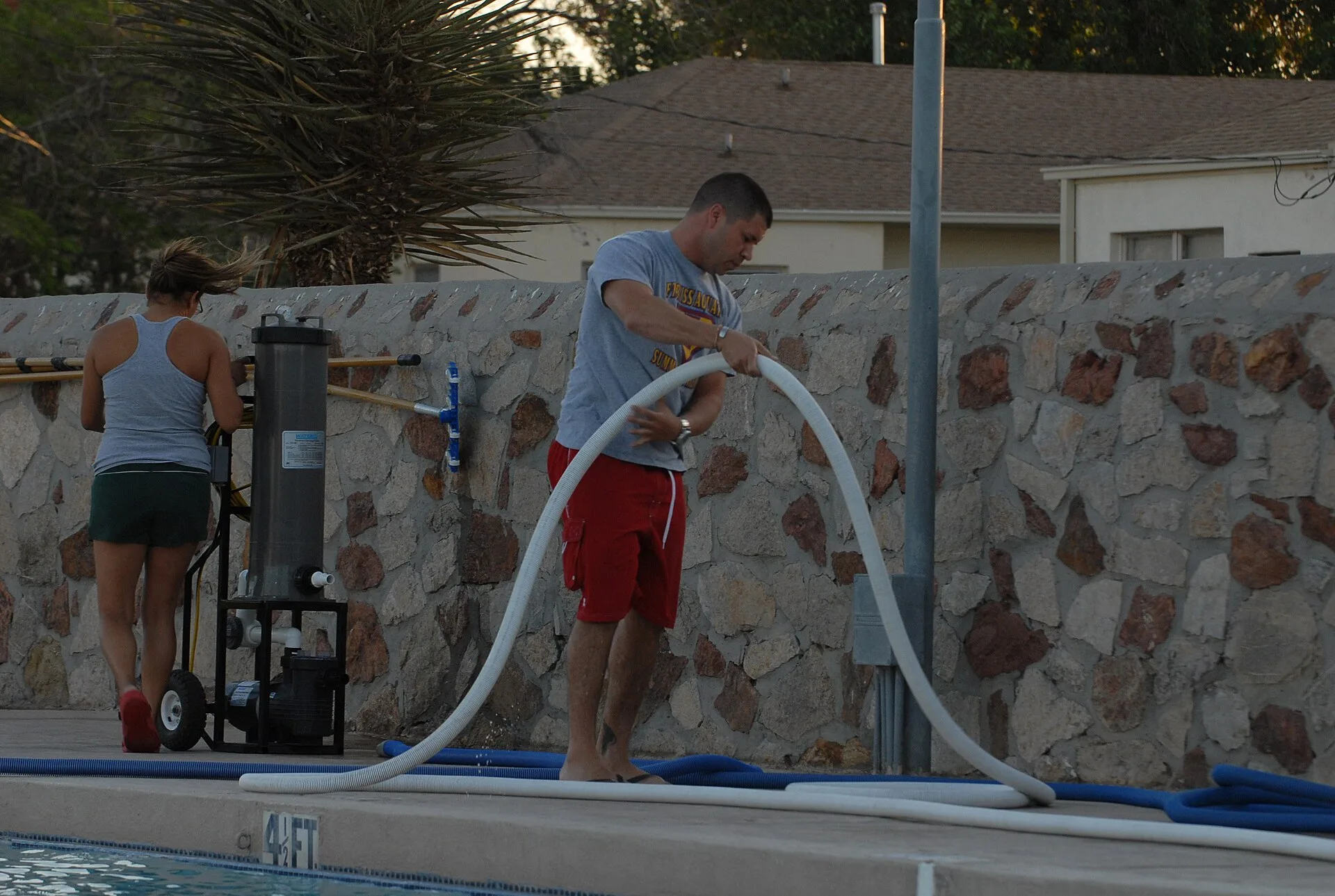
A technician drives a fixed list of stops, tests and adjusts water, cleans what needs cleaning, checks equipment, and leaves a record. Repairs come off the same visits: the person at the pad notices the pump cavitating.
That shape has consequences. Revenue is recurring and predictable, which is the good part. Capacity is capped by hours and geography, which is the hard part. You cannot serve a customer twenty minutes away as profitably as one two streets over, no matter what you charge.
Sizing a market before you commit
Four things decide whether an area can carry a route.
| Factor | What to look at | Why it decides |
|---|---|---|
| Pool density | Pools per square mile in the neighborhoods you can reach | Sets how many stops fit in a day |
| Season length | Months when pools stay open in that climate | Sets how many months bill |
| Pool mix | Plaster, vinyl, fiberglass; salt against traditional chlorine; spas and water features | Sets chemical cost, labor time, and the skills you must hire for |
| Competition shape | Many one-truck operators, or a few large firms | Decides whether you compete on availability or on price |
Do the density work on foot and on a map, not from a spreadsheet, and drive a candidate neighborhood at the hours you would service it.
Count gates and pool equipment pads visible from the street, then time the drive between the far corners. If crossing the territory takes longer than servicing two pools, the territory is drawn wrong.
The three revenue lines
Recurring service is the base. It pays the truck, the insurance, and the technician, and it is what a buyer values if you ever sell.
Chemicals are either included in the service price or billed on top. Both work. Including them is simpler for the customer and hides the cost of a bad summer, when chlorine demand runs high.
Billing separately keeps your margin honest and makes the customer feel the cost of a pool they never cover. Pick one and apply it consistently, because a route with both cannot be priced.
Repairs carry the best margin and the worst predictability. Pumps, motors, filters, heaters, salt cells, and automation all fail on their own schedule. A new owner should treat repair income as a bonus rather than as part of the plan, at least until a full season shows what the route actually breaks.
Build a route or buy one
Building is slow and cheap. You add stops one at a time, you learn each pool, and your cost is time. Buying is fast and expensive, and the risk is retention: some customers were loyal to the person, not the company.
If you buy, ask for service history per account, not a revenue total. You want each customer's time on the route, skip frequency, and callback count.
A route where a few accounts produce most callbacks has a chemistry problem you are about to inherit.
The paperwork that comes first
Register the business and get the tax identification before the first invoice. Internal Revenue Service: Starting a business covers the federal side: business structure, employer identification, and tax obligations based on how you set it up.
Your state and city add a layer, and pool work often requires a contractor or specialty license once you touch equipment, not water alone. The class is named differently in each state: California issues a C-53 Swimming Pool Contractor license, and Florida licenses Certified Pool/Spa Contractors. Water treatment on its own usually stays outside those classes, which is exactly why the line needs checking before you advertise.
U.S. Small Business Administration: Plan your business is a reasonable place to work through market research, the plan itself, and the startup cost arithmetic. It also points at free local counseling, which is worth more to a first-time owner than another template.
For pay expectations in your own metro, U.S. Bureau of Labor Statistics: Occupational Employment and Wage Statistics Tables publishes wage estimates by occupation, state, and metropolitan area. Use it as one input when you decide what a technician costs you, not as a quote.
If your route will include an apartment complex, HOA, or hotel, the rules change before the first stop. Centers for Disease Control and Prevention: Operating and Managing Public Pools, Hot Tubs and Splash Pads sets out what public aquatic facilities are expected to maintain: trained operators, documented water testing, working recirculation and filtration, and chemical safety practices.
Many health departments require a certified operator for those accounts, and the credential those codes usually name is the Certified Pool Operator (CPO), issued by the Pool & Hot Tub Alliance. Find out what your county accepts before you quote one.
What the first ten customers really cost you in time
New owners underestimate acquisition because the money spent is small. The cost is time, and it is concentrated.
Each early account needs a quote visit, a first service that runs long because the pool is unfamiliar, and often a correction period as you learn what it does between visits.
Expect first visits to any new pool to take noticeably longer than routine ones. Some early accounts will need a conversation about a condition they did not disclose.
That is why the first ten should be close together and similar to each other. Similar pools compress the learning, and close pools compress the driving. An owner who spends the first month learning ten different pool types in ten different neighborhoods has paid twice for the same education.
What the first season should teach you
Month one is licensing, insurance, the vehicle, and the chemical storage setup. Month two is your first accounts, priced deliberately high enough to survive, and a service record written for every visit from the very first one. Month three is when you learn your real stop time, which will be longer than you assumed. Adjust the route, not the standard.
By the end of the first season you should be able to answer three questions with your own data: how many stops fit in a day, what a stop actually costs you, and which accounts generate the callbacks. Nothing about growth is worth discussing until those three have answers.
Common questions
How many accounts does a one-truck route need?
Enough that a full week of stops leaves room for repairs and for the pool that goes green. The number depends on your stop time and your drive time, both of which you have to measure rather than assume. Count backward from the hours in your week.
Is it better to start part time?
It is a reasonable way to learn the work, and it removes the pressure to accept accounts on the far edge of the map. The limit is availability. Customers with a green pool in July call whoever answers, and a part-time route often cannot answer.
Do I need a license to clean pools?
Cleaning and water treatment sit differently from equipment repair in most jurisdictions, and the line moves from state to state. Ask your state contractor board and your county health department directly, and get the answer in writing before you advertise a service you are not licensed to sell. A CPO credential is an operator certification, and it does not replace a contractor license where one is required.
What kills new pool routes fastest?
Underpriced accounts that are too far apart. A cheap stop across town costs you the same hour as a profitable one nearby, and an owner who fills a schedule that way spends a season working hard for nothing.